
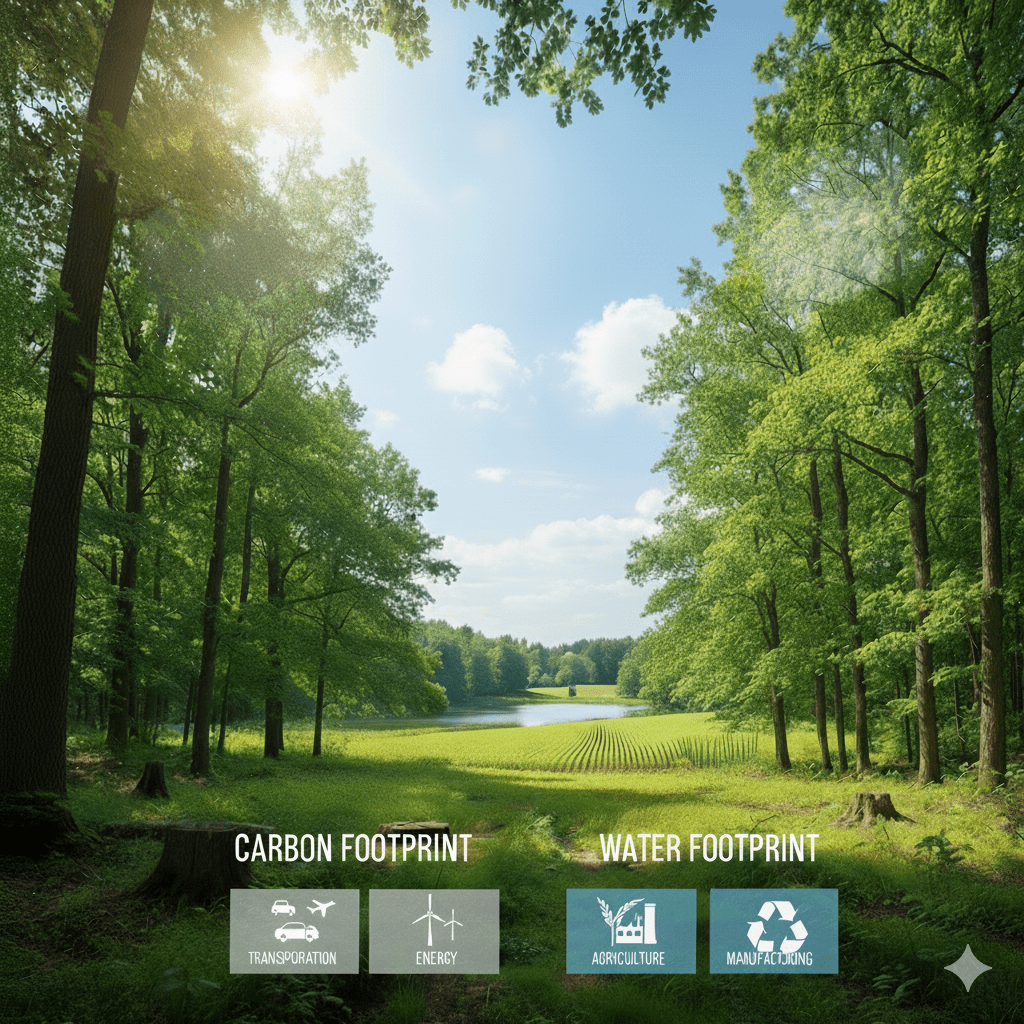
Carbon Footprint and Water Footprint:
New Paradigms for the Manufacturing and Technology Industries
In today’s industrial landscape, environmental sustainability has evolved from a simple option to a strategic imperative. Among the most effective tools for measuring and managing the impact of production activities are two fundamental concepts: the Carbon Footprint and the Water Footprint.
International ISO standards provide the essential methodological framework for quantifying and managing environmental impacts, transforming Carbon and Water Footprint concepts from abstract ideals into tangible strategic tools.
What are we talking about?
Carbon Footprint: This measures the total emissions of greenhouse gases (GHG), expressed in CO₂ equivalent, generated directly and indirectly by an organization, event, product, or individual. It includes energy consumption, production processes, transportation, and waste disposal.
The methodological approach is defined by a series of complementary standards:
- ISO 14064-1:2018: Specifies principles and requirements for quantifying and reporting greenhouse gas (GHG) emissions and removals at the organizational level. It is the reference standard for companies publishing sustainability reports, enabling the measurement of direct emissions (Scope 1), indirect emissions from purchased energy (Scope 2), and other indirect emissions in the value chain (Scope 3).
- ISO 14067:2018: Defines requirements for quantifying the carbon footprint of a product (CFP – Carbon Footprint of a Product), based on the principles of Life Cycle Assessment (LCA – ISO 14040/14044). This standard is crucial for eco-design and environmental labeling.
Water Footprint: This assesses the total use of freshwater, considering not only direct consumption (blue water) but also pollution (grey water) and rainwater evaporated during production processes (green water). It provides a holistic view of the water stress caused by an activity.
For water, an international reference standard also exists:
- ISO 14046:2014: Specifies principles, requirements, and guidelines for assessing the water footprint of products, processes, and organizations based on life cycle assessment (LCA). It is fundamental because it goes beyond measuring the volume of water withdrawn and evaluates related environmental impacts, such as water scarcity and pollution.
Applicability to the Manufacturing Sector
- Process Optimization: Mapping the entire product life cycle (LCA – Life Cycle Assessment) to identify emission and water consumption “hotspots.” This leads to intervention plans including high energy-efficiency machinery, heat recovery systems, and closed water circuits, drastically reducing withdrawals and discharges.
- Sustainable Supply Chain (Scope 3): A manufacturing company cannot claim to be sustainable if only its facilities are. ISO standards push companies to look beyond their own boundaries, requiring suppliers to report their emissions (ISO 14064-1) or water footprint (ISO 14046), thereby identifying risks and inefficiencies upstream.
- Circular Economy: Reducing production waste and implementing recycling lowers both the carbon footprint (less energy required for new production) and the water footprint.
- Product Innovation and Eco-design: ISO 14067 (for product carbon footprint) serves as a guide for R&D teams, providing objective data for selecting lower-impact materials, extending product lifespan, and improving energy efficiency.
- Communication and Credibility: A label displaying a product’s carbon footprint calculated according to ISO 14067 holds credible and verifiable value for consumers and investors, protecting against the risk of “greenwashing.”
- Risk Management: ISO 14046 helps companies map their exposure to geographical water risk, enabling them to diversify supplies or invest in water recycling technologies to mitigate this risk.
QU-ESAR CONSULT
positions itself as the ideal partner to guide companies through the process of identification, reporting, and analysis required to direct investments toward making production increasingly competitive and sustainable.
The integrated measurement and management of Carbon and Water Footprints are no longer just a reporting exercise but have become critical competitiveness factors. They drive innovation, reduce operational costs (through efficiency), mitigate regulatory risks, and respond to the growing demand for transparency from investors and consumers.
The ISO 14064, 14067, and 14046 standards provide the common language and scientific rigor needed to transform environmental sustainability into a management discipline. Their application is not merely about compliance but represents a strategic investment that enables informed decision-making, sustainable innovation, ensures supply chain resilience, and builds a reputation for genuine green leadership in the global market.

 qu-esarconsult.com